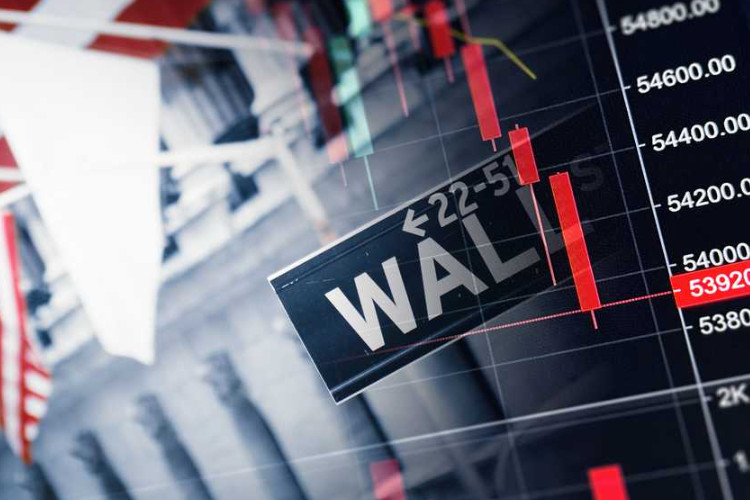
Stocks Suffer: Is a 2007-Style Correction Brewing Amid Fed Shifts?
The financial markets are once again gripped by uncertainty, with headlines declaring that stocks suffer significant losses across the board. From major indices tumbling to corporate giants issuing stark warnings, investors are understandably anxious. The burning question on many minds is whether current conditions are merely a temporary dip or if they signal a deeper, more prolonged downturn reminiscent of the pre-2007 financial crisis era, especially as the Federal Reserve contemplates its next moves.
Recent market turbulence has seen a confluence of factors, from geopolitical tensions and trade policy shifts to an evolving macroeconomic landscape. This article delves into the forces at play, examining the parallels to past market corrections, the Fed's critical role, and what investors can do to navigate these choppy waters.
The Current Economic Storm: Why Stocks Suffer
Several significant headwinds have converged, contributing to the recent market pain. A cocktail of global trade concerns, softening corporate outlooks, and rising investor fear has pushed equity markets into a defensive stance, making headlines about how stocks suffer a common sight.
Global Trade Tensions and Tariff Worries
Much of the recent market apprehension can be traced back to renewed speculation surrounding global trade policy, particularly regarding increased tariffs on Chinese goods, including high-technology products. The prospect of an escalating trade war, fueled by discussions around prominent economic plans, has injected a substantial degree of unpredictability into global supply chains and corporate earnings forecasts. This uncertainty played a direct role in the Nasdaq experiencing one of its weakest trading sessions since mid-December 2022, highlighting the sensitivity of growth-oriented sectors to trade policy shifts. For a deeper dive into how these factors impact tech-heavy indices, read our related article: Nasdaq's 2022 Low: How Tariffs and Trump's Plan Impact Markets.
The economic ramifications of such tariffs extend beyond just direct import/export costs. They can lead to higher consumer prices, reduced corporate profitability for companies reliant on international trade, and ultimately, a drag on overall economic growth. In such an environment, the US dollar has shown a muted weakening, a trend that could quickly reverse if US stock indices continue to trade in the red, indicating a potential flight to safety or a reassessment of global economic stability.
Corporate Warnings Sound the Alarm
Adding to the gloomy sentiment, major corporations are beginning to signal trouble ahead. A prime example is FedEx (FDX), which recently withdrew its full-year outlook, citing weakening global shipment volumes alongside a worsening global economy. This move by a bellwether of global trade sent shivers through the market, as it provided tangible evidence that economic slowdowns are not just theoretical but are impacting real-world business operations and consumer demand.
Following this significant corporate warning, the broader market dove headfirst into a steep tumble. All three major indexes—the Dow Jones Average, the S&P 500 Index, and the Nasdaq Composite—each posted weekly losses of 4% or worse. The Dow, for instance, plunged 4.1% for the week, while the S&P 500 shed 4.8%, and the Nasdaq saw a 5.4% decline. These marked their worst weekly performances since June, underscoring the severity of the market reaction to fading economic hope. This period vividly illustrates how rapidly Stocks Plunge 4% Weekly as Economic Hope Fades and FedEx Warns.
The Market's Fear Gauge: A Rising VIX
As stocks suffer, the Cboe Volatility Index (VIX), often dubbed the market's "fear gauge," has predictably spiked. During periods of heightened uncertainty, the VIX tends to rise, reflecting increased expectations of market volatility over the next 30 days. The index recently added 15.4% for the week, a clear signal that investor anxiety is escalating. A higher VIX suggests that market participants are bracing for larger price swings, a common characteristic of correction or bear market environments. This rise in implied volatility underscores the prevailing sentiment that the path ahead for equities is likely to be turbulent.
The Fed's Pivoting Stance and the Echo of 2007
A crucial element in the current market narrative is the Federal Reserve's evolving monetary policy. Central bank actions, or even the mere anticipation of them, can exert immense influence on market direction. The current situation bears an uncanny resemblance to the period prior to the September 2007 Fed rate cut, prompting many to wonder if history is about to repeat itself.
Rate Cut Speculation and Yield Dynamics
Speculation about future Fed rate cuts is a significant driver of market sentiment. Historically, bond yields tend to decrease ahead of the first rate cut by the Fed. We've seen precisely this trend play out, with the 10-year US Treasury yield experiencing a downward move that started in early July and could potentially push it down to the 3.70% area. A falling yield typically signals expectations of lower future interest rates, which can be a double-edged sword: good for borrowing costs and potentially equity valuations, but often also indicative of slowing economic growth.
If the Fed does indeed begin to cut rates, it's usually in response to a perceived weakening of the economy or a desire to stimulate growth. This complex interplay between rates, yields, and economic health is what makes the Fed's next moves so critical for investors trying to decipher whether the current market downturn is a temporary blip or a more entrenched correction.
A Dovish Shift on the Horizon?
Adding further intrigue to the Fed's outlook, the latest Beige Book report revealed an increased possibility of a "soft landing" for the economy. While this might sound reassuring, investors are keenly watching the words of individual Fed members for more concrete signals. Upcoming speeches from Fed members Logan, Daly, and Bowman are particularly anticipated. Of these, Bowman is a 2025 voter and known hawk. A significant dovish shift in her commentary could be a powerful indicator of a mood change within the Federal Reserve Board, cementing expectations for future rate cuts and potentially influencing market direction.
A "dovish shift" implies that even traditionally hawkish members are becoming more concerned about economic growth and are leaning towards more accommodative monetary policy. Such a shift could signal that the Fed believes the risk of an economic downturn outweighs the risk of persistent inflation, setting the stage for a policy pivot that could alter the trajectory of the market.
The 2007 Playbook: What if History Rhymes?
The striking resemblance to the period prior to the September 2007 Fed rate cut has investors and analysts drawing parallels. If history were to rhyme—not necessarily repeat identically—the S&P 500 index could experience a further correction towards the 5,100 level. Such a move would represent a substantial drawdown from recent highs, marking a significant correction phase.
Beyond equities, currency markets could also see major shifts. The dollar/yen pair, for instance, might drop to the 148-yen area, possibly assisted by repeated interventions from the Bank of Japan (BoJ) to support its currency. While no two market cycles are identical, the underlying mechanics—a slowing economy, anticipated Fed easing, and global financial interconnectedness—create an environment ripe for historical comparisons. In 2007, the Fed cut rates amid growing concerns about the subprime mortgage crisis, which ultimately preceded a major financial downturn. Today, concerns revolve around inflation, geopolitical stability, and corporate health. Understanding these potential outcomes, even if not certainties, helps investors contextualize the current volatility.
Navigating Volatile Markets: Investor Strategies
When stocks suffer and uncertainty reigns, panic can set in. However, disciplined investors understand that such periods, while challenging, can also present opportunities for those who remain calm and strategic. Here are some practical tips for navigating volatile markets:
- Revisit Your Asset Allocation: Ensure your portfolio's diversification aligns with your long-term goals and risk tolerance. Diversifying across different asset classes (equities, bonds, real estate, commodities), geographies, and sectors can help cushion against downturns in any single area.
- Focus on Quality and Fundamentals: In uncertain times, financially strong companies with solid balance sheets, consistent earnings, and competitive advantages tend to weather storms better. Resist the urge to chase speculative "meme" stocks and instead focus on businesses with robust fundamentals.
- Consider Dollar-Cost Averaging: Instead of trying to time the market, invest a fixed amount of money at regular intervals. This strategy, known as dollar-cost averaging, allows you to buy more shares when prices are low and fewer when they are high, potentially reducing your average cost over time.
- Stay Informed, Not Obsessed: Keep abreast of economic news, Fed announcements, and corporate earnings, but avoid constant monitoring that can lead to emotional decisions. Differentiate between noise and genuinely impactful information.
- Review Your Emergency Fund: Ensure you have adequate liquid savings to cover several months of living expenses. This prevents you from being forced to sell investments at a loss if unexpected financial needs arise.
- Look for Opportunities: Market downturns can present opportunities to acquire quality assets at lower prices. Identify companies or sectors that you believe have strong long-term prospects and consider gradually adding to those positions.
Conclusion
The current market environment, characterized by global trade tensions, corporate warnings, and an anxious Federal Reserve, clearly indicates that stocks suffer significant pressure. While the echoes of 2007 are hard to ignore, it's crucial to remember that every economic cycle has its unique drivers and nuances. The possibility of a significant market correction, driven by a combination of factors and potentially exacerbated by a Fed pivot, remains a tangible concern for investors.
As the market watches closely for signals from the Fed, corporate reports, and geopolitical developments, prudent investing strategies become paramount. By focusing on diversification, fundamental analysis, and a long-term perspective, investors can better position themselves to weather the current storm and potentially emerge stronger when stability eventually returns. The path ahead may be volatile, but informed decision-making remains the best compass for navigating these turbulent financial seas.